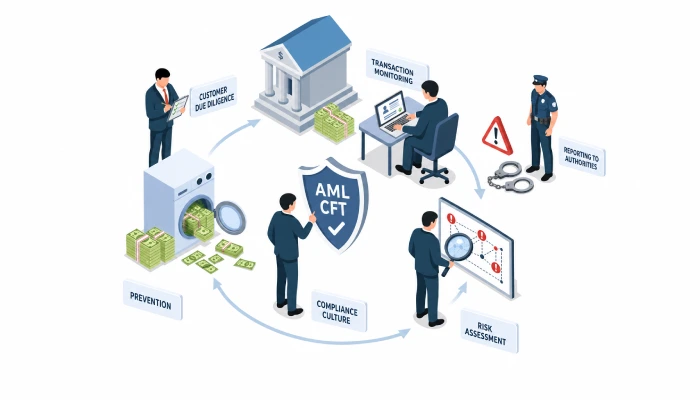
EU AML/CFT is the European Union’s legislative and institutional framework designed to prevent and combat money laundering and terrorist financing.
Page updated date: 05.11.2026
The EU’s Anti-Money Laundering and Countering the Financing of Terrorism (AML/CFT) framework centers on a major legislative overhaul designed to create a single, harmonized rulebook across member states.
Core Pillars of the EU AML/CFT Package
-
Directive (EU) 2015/849 (Fourth Anti-Money Laundering Directive or 4AMLD) (until 2027):
European Union law adopted on May 20, 2015. It aims to prevent the use of the EU's financial system for money laundering and terrorist financing by updating and tightening risk-based rules across member states.
Key Objectives & Core Measures
• Risk-Based Approach: Requires financial institutions and designated non-financial professions to identify, assess, and understand the money laundering and terrorist financing risks they face.
• Customer Due Diligence (CDD): Mandates standard, simplified, and enhanced customer due diligence measures, especially for high-risk third countries.
• Beneficial Ownership Transparency: Requires corporations, trusts, and legal entities to obtain and hold adequate, accurate, and current information on their ultimate beneficial owners in central national registers.
• Scope of Regulated Sectors: Covers credit institutions, financial institutions, auditors, accountants, tax advisors, notaries, lawyers, real estate agents, gambling services, and high-value cash/art traders.
• Information Exchange: Strengthens cooperation and data sharing among national Financial Intelligence Units (FIUs) and supervisory authorities across borders.
Evolution & Status
• Adoption & Transposition: Adopted on May 20, 2015, entered into force in June 2015, and had a national transposition deadline of June 26, 2017.
• Amendments: Substantially amended by Directive (EU) 2018/843 (5AMLD) and later legislative acts (such as Regulation (EU) 2023/1113 on crypto-assets) to address new technological and virtual currency risks.
• Current Status: The framework has been superseded/integrated into newer EU anti-money laundering packages (such as Directive (EU) 2024/1640), concluding its active standalone operational lifecycle until July 10, 2027. -
Directive (EU) 2024/1640 (Sixth Anti-Money Laundering Directive or AMLD6) (from 2027):
• Governs national implementation, detailing the powers and tasks of national competent authorities (NCAs) and Financial Intelligence Units (FIUs).
• Requires centralized beneficial ownership registers, interconnected bank and crypto account access mechanisms, and real estate single access points.
-
Regulation (EU) 2024/1624 (Anti-Money Laundering Regulation or AMLR):
Directly applicable law across all EU member states, standardizing customer due diligence, beneficial ownership, and reporting obligations without needing national transposition.
• Pursuant to Article 90, the Act enters into force on July 10, 2027; for football agents and professional clubs, it enters into force on July 10, 2029.
• Establishes a direct-applying Single Rulebook across all EU Member States to eliminate regulatory differences.
• Sets an EU-wide maximum cash payment limit of €10,000.
• Mandates customer due diligence (CDD) starting at €3,000 for cash transactions and €2,000 for gambling services.
• AMLA directly supervises high-risk, cross-border financial entities via Joint Supervisory Teams (JSTs)
• Expands the list of obliged entities to include crypto-asset service providers (CASPs), crowdfunding platforms, investment migration operators, professional football clubs and agents, and high-value goods traders.
General
-
Regulation (EU) 2024/1620 (AMLA Regulation):
• Establishes the Anti-Money Laundering Authority (AMLA) based in Frankfurt, Germany.
• AMLA will oversee regulatory standards, coordinate national Financial Intelligence Units (FIUs), and assume direct supervision of high-risk cross-border financial and credit institutions starting in January 2028. -
Expanded Scope of Obliged Entities:
• Rules now explicitly cover Crypto-Asset Service Providers (CASPs) under the Markets in Crypto-Assets (MiCA) alignment.
• Extended to crowdfunding providers, mortgage intermediaries, luxury goods traders (e.g., jewellery over €10,000, vehicles over €250,000), football clubs, and investor residence ("golden visa/passport") scheme operators. -
Cash Limits and Tracking:
• Imposes an EU-wide maximum limit of €10,000 on large cash payments, with stricter due diligence kicking in at a €3,000 threshold. -
The Recast Transfer of Funds Regulation (ToFR / Travel Rule):
• Extends traditional wire-transfer traceability rules to crypto-asset transfers, requiring CASPs to collect and share originator and beneficiary information.
Anti-Money Laundering: The Legal basis of the Republic of Moldova
Disclaimer
The e-Legal AML/CFT AI Consultant provides exclusively informational and advisory services: it clarifies AML/CFT legal requirements, conducts a legal analysis of the content of submitted internal documents within the scope of an agreed-upon assignment, and prepares recommendations and draft amendments that are purely advisory in nature.
The e-Legal AML/CFT AI Consultant does not assume the role of the person responsible for ensuring a client’s AML/CFT compliance; it does not approve, implement, or monitor the ongoing execution of a client’s policies and procedures; it does not conduct due diligence on clients or beneficial owners, assess the risks of specific clients or transactions, monitor transactions, make decisions regarding the execution or suspicious nature of transactions, submit mandatory reports to the SPCSB, perform statutory AML audits, or certify that a client’s operations comply with AML/CFT requirements. Furthermore, the service does not include the preparation, execution, or facilitation of financial, property, or corporate transactions for the client, the formation or management of companies, the management of assets or accounts, or the provision of fiduciary services.
The outcome of the consultation is limited to a legal assessment of the submitted documents as of an agreed-upon date; it does not confirm that the client has effectively fulfilled AML/CFT requirements, nor does it replace the performance of obligations by the client or their authorized representatives. The use of the consultant’s name or its findings as confirmation of a client’s full AML/CFT compliance—or the designation of the consultant as the party responsible for such compliance—is not permitted.



