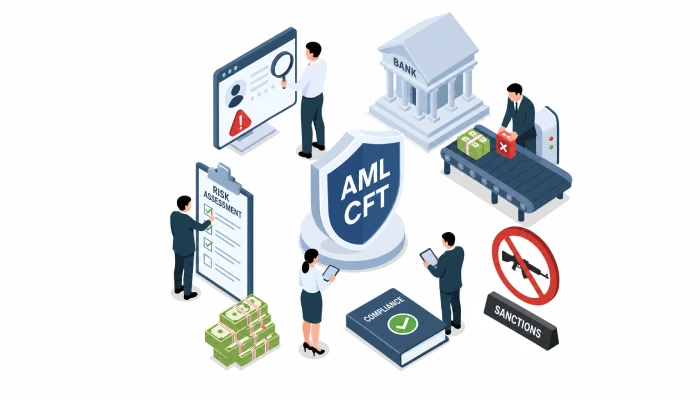
Law No. 308/2017 "On Prevention and Combating Money Laundering and Terrorist Financing" is the primary law governing the fight against money laundering in Moldova.
This Law establishes measures to prevent and combat money laundering and the financing of terrorism, contributing to the assurance of state security, with the aim of protecting the national financial-banking and non-banking financial systems and liberal professionals, as well as safeguarding the legitimate rights and interests of natural and legal persons and of the State.
This Law applies to acts of money laundering, predicate offenses, and acts involving the financing of terrorism and the proliferation of weapons of mass destruction committed—directly or indirectly—by citizens of the Republic of Moldova, foreign nationals, stateless persons, and legal entities resident or non-resident in the Republic of Moldova, as well as—in accordance with international treaties to which the Republic of Moldova is a party—to acts committed by such persons outside the territory of the Republic of Moldova.
Where a transaction or operation is carried out in foreign currency, the official exchange rate of the Moldovan leu against that foreign currency, as established by the National Bank of Moldova and valid on the day the transaction or operation is performed, shall be applied to determine its equivalent in Moldovan lei for the purposes of implementing the provisions of this Law.
The financial intelligence unit of the Republic of Moldova is the Service for Prevention and Combating Money Laundering, hereinafter referred to as the Service.
Reporting entities
(1) The following natural and legal persons, hereinafter referred to as reporting entities, fall within the scope of this Law:
a) banks;
b) currency exchange units (other than banks);
c) investment firms;
d) registry companies, the Single Central Securities Depository;
e) insurers or reinsurers and insurance and/or reinsurance intermediaries carrying out activities within the scope of life insurance classes, including those with investment participation;
f) administrators of voluntary pension funds, investment management companies;
g) non-bank credit organizations, savings and loan associations;
h) real estate agents, including when acting as intermediaries in the leasing of real estate, but only regarding transactions where the monthly rent value exceeds 200,000 lei;
i) payment institutions, electronic money institutions, and postal service providers—excluding account information service providers and payment initiation service providers—operating in accordance with Law No. 114/2012 on payment services and electronic money;
j) lawyers, notaries, authorized administrators, bailiffs, mediators, and other liberal professionals, when they provide assistance in the preparation or execution of transactions for their clients regarding the purchase or sale of real estate, shares or equity interests, or elements of a business (goodwill), the management of financial instruments, securities, or other client assets, operations or transactions involving a sum of money or a transfer of ownership, the opening or management of bank, savings, or securities accounts, the organization of the subscription process for capital contributions required for the incorporation, operation, or management of a company, the incorporation, management, or administration of such companies, of undertakings for collective investment in transferable securities, or of other similar structures, as well as when they participate, on behalf of or for their clients, in any financial or real estate transaction, or in the creation, operation, or administration of trusts, companies, foundations, or similar structures;
k) gambling operators;
l) auditors, legal entities, and sole traders providing accounting and tax consultancy services as their primary economic or professional activity;
m) other natural and legal persons trading in goods (including natural and legal persons dealing in precious metals and precious stones) in an amount of at least 200,000 lei or the equivalent thereof, solely where payments are made in cash, regardless of whether the transaction is carried out in a single operation or in several operations that appear to be linked;
n) natural/legal persons carrying out fiduciary activities, other than those referred to in points (f) and (j);
o) persons who store or trade in works of art or act as intermediaries in the trade of works of art, including where this activity is carried out by art galleries and auction houses, as well as by residents of free economic zones, if the value of the transaction or of the linked transactions/operations amounts to 200,000 lei or more;
p) crowdfunding service providers;
q) trust or company service providers.
Standard customer due diligence measures
(1) Reporting entities apply standard customer due diligence measures:
a) when establishing business relationships;
b) when carrying out all types of occasional transactions:
– amounting to more than 20,000 lei – if the transaction is carried out in a single operation via payment service providers, including through the use of electronic means;
– amounting to more than 200,000 lei – if the transaction is carried out through one or more linked operations, taking into account national requirements;
c) in the case of gambling service providers, at the time of collecting winnings, purchasing or exchanging chips, or placing a wager when carrying out transactions amounting to at least 40,000 lei, regardless of whether the transaction is carried out in a single operation or through several linked operations;
d) when there is a suspicion of money laundering or terrorist financing, regardless of any derogations, exemptions, or thresholds established;
e) when there are suspicions regarding the veracity, adequacy, and accuracy of previously obtained identification data;
f) in the case of persons trading in goods, when carrying out occasional cash transactions amounting to at least 200,000 lei, regardless of whether the transaction is carried out in a single operation or through several operations that appear to be linked.
(2) Standard customer due diligence measures comprise:
a) identifying and verifying the customer's identity on the basis of identity documents, as well as documents, data, or information obtained from a reliable and independent source, including—where available—electronic identification means, relevant trust services, or any other secure, remote, or electronic identification process regulated, recognized, approved, or accepted by the supervisory authorities;
b) identifying the beneficial owner and taking reasonable, appropriate, and risk-based measures to verify their identity, using relevant documents, data, and information obtained from a reliable source, so that the reporting entity is satisfied that it knows who the beneficial owner is and understands the customer's ownership and control structure;
c) assessing and understanding the purpose and intended nature of the business relationship and, where necessary, obtaining additional information regarding them;
d) continuous monitoring of the business relationship, including the scrutiny of transactions undertaken throughout the course of that relationship, to ensure that the transactions performed are consistent with the information held by the reporting entities regarding the customer, the business profile, and the risk profile—including the source of funds—and that the documents, data, or information held are up to date.
(21) When assessing the purpose and nature of the business relationship, reporting entities are required to take into account at least one of the following factors:
a) the purpose of initiating the business relationship or carrying out an occasional transaction;
b) the type of services requested;
c) the destination of the payment;
d) the volume of assets deposited or the size of transactions performed by the customer;
e) the frequency of transactions and the potential duration of the business relationship.
(3) Where it is not possible to apply standard customer due diligence measures, reporting entities are required not to carry out any activity or transaction—including through a payment account—or establish any business relationship, or to terminate an existing business relationship, and to submit the special forms regarding the reporting of suspicious activities or transactions to the Service in accordance with the provisions of Art. 11. In this case, reporting entities are entitled not to explain the reason for the refusal to the client.
(31) Where there is a suspicion of money laundering or terrorist financing, reporting entities shall not complete standard customer due diligence measures if they reasonably believe that doing so would result in a breach of the non-disclosure obligation; instead, they shall submit to the Service the special form for reporting suspicious activity or transactions concerning the potential client, in accordance with the provisions of Art. 11.
International Cooperation and Law Enforcement
Moldova is actively aligning its mechanisms with the standards of MONEYVAL (a Council of Europe committee) and the FATF, with support from international experts. Law enforcement agencies place particular emphasis on disrupting complex criminal schemes.
Regulatory framework of the Republic of Moldova
I. Laws
- Law No. 308/2017 on the prevention and combating of money laundering and terrorist financing
- Law No. 75/2020 on the procedure for detecting violations in the field of preventing money laundering and terrorist financing and the manner of applying sanctions
II. Decisions of the Parliament, National Bank and Government
- Parliament Decision No. 140/2026 approving the National Program on Preventing and Combating Money Laundering, Terrorist Financing, and the Proliferation of Weapons of Mass Destruction for the years 2026–2030
- Decision of the National Bank of Moldova No. 281/2024 approving the Regulation on requirements for the identification and verification of customer identity via electronic means (e-KYC)
- Government Decision No. 167/2024 approving the list of jurisdictions and autonomous regions that do not implement international transparency standards
- Government Decision No. 896/2023 approving the methodology for determining jurisdictions and autonomous regions that do not implement international transparency standards
III. Orders of the SPCSB
- Order No. 21 of 04.08.2024 amending the Regulation on requirements regarding the prevention and combating of money laundering and terrorist financing for entities supervised by the Service for Prevention and Combating Money Laundering, approved by Order No. 21 of 04.08.2023
- Order No. 23 of 06.09.2023 approving the Guide on the identification and monitoring of politically exposed persons and risk indicators regarding politically exposed persons
- Order No. 22 of 15.08.2023 approving the list of important public functions at the national level that determine the status of a politically exposed person
- Order No. 21 of 04.08.2023 approving the Regulation on requirements regarding the prevention and combating of money laundering and terrorist financing for entities supervised by the Service for Prevention and Combating Money Laundering
- Order No. 16 of 20.07.2023 approving the Guide on identifying transactions and activities suspected of terrorist financing
- Order No. 15 of 20.07.2023 approving the Guide on identifying activities or transactions suspected of money laundering
IV. Guides and recommendations
- Guideline on the identification of the beneficial owner, amended by Order No. 9 of May 29, 2025
- Methodological manual on the application of measures to prevent and combat money laundering and terrorist financing by other professional participants
- Methodology regarding the completion and submission of special forms concerning activities or transactions subject to Law No. 308/2017 on preventing and combating money laundering and terrorist financing



